The Knoxville buyer in spring 2026 walks into the house already deciding. Rates haven't budged, renovation budgets are gone, and the first walkthrough is rarely about what's there — it's about what's going to need fixing. The seller's job, before the sign goes in the yard, is to take that imagined punch list off the table.
After enough showings on both sides of the deal — agent and tour-guide — patterns become hard to miss. The buyers who walk through your home aren't running a property inspection. They're scanning, fast, for the cues that tell them this house has been loved or this house has been ignored. The first impression is mostly unconscious, which is exactly why it's useful to know what they actually look at, in the order they look at it.
The good news: the things buyers notice aren't expensive. They're attention.
The first thirty seconds
Every showing has a window where the buyer's mind is still open. It's roughly thirty seconds long. They walk up the path, take in the front of the house, step into the foyer, glance toward the living room or kitchen, and form a working theory: someone takes care of this house, or someone has been meaning to. Almost everything that happens after that thirty seconds either reinforces or revises that theory. Almost nothing changes it.
That's why the front door, the foyer, and the line of sight from the foyer matter more than the powder room. Those are the rooms that set the lens for everything that comes after.
The foyer is the first room. It's also the room sellers most underestimate.
What buyers actually notice (the list)
This is the list, in roughly the order they see it. None of it requires a contractor. Most of it requires a Saturday and a willingness to look hard at your own house — which, to be honest, is the part most sellers cannot do alone. We get blind to our own rooms.
The cues a buyer reads in the first walkthrough
The front door. Peeling paint, dirty hardware, a dead seasonal plant on the porch step. The door is the handshake. If it feels sticky, the house feels neglected.
Light, everywhere. Burnt-out bulbs, dim corners, blinds half-down. Every room has to read bright. Buyers equate light with care.
Smell. Last night's dinner, the dog, candles trying too hard. If you live there, you can't smell it. Ask a friend who'll tell you the truth.
Baseboards and door trim. The dust line and the scuffs. Buyers don't articulate this. They just feel "tired."
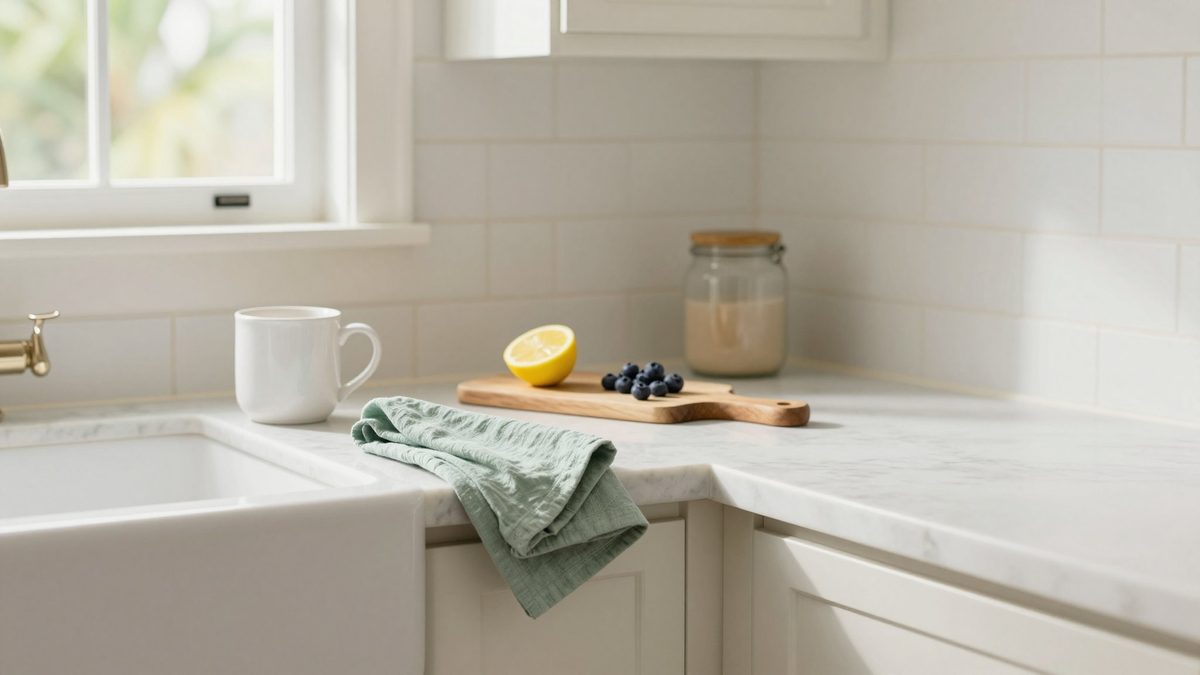
Kitchen edges. The grease line on the stovetop, the grout color shift behind the sink, the gap between the fridge and the cabinet. The kitchen tells the truth about how the house has been kept.
Bathroom caulk and grout. Yellowing caulk, mold spots in the corner of the shower. Replace caulk for four dollars a tube. From across the room it reads as a four-hundred-dollar job.
Window glass and sills. Fingerprints, dust, a dead fly. Light doesn't come in clean through a dirty pane.
The yard, viewed from the curb. Edged or not, mulch refreshed, gutters not full of leaf debris. The drive-by is part of the showing.
Closet density. Every closet stuffed shut signals "not enough storage" no matter how much storage there actually is. Pull a third of it out.
Door hardware. Sticky locks, loose handles, anything that doesn't feel solid. Buyers touch hardware constantly without knowing they're doing it.
Buyers don't audit your house. They feel it. The job before the listing photographer shows up is to make sure every cue points the same direction.
— Hilary Kilgore
The kitchen tells the truth about the house. Spotless edges read as "this one has been kept."
What buyers don't notice (skip these)
Just as useful is the list of things that look like prep but aren't. Sellers spend money here, and the buyer never registers it.
Trendy paint colors. Most buyers are repainting anyway. Play it safe with a warm white or soft greige.
New light fixtures, beyond replacing what's clearly broken. Builder-grade is fine if it's clean and works.
Big landscaping projects. A buyer can't tell the difference between two hundred dollars of mulch and two thousand of new beds. Spend the two hundred.
Kitchen backsplash replacements as a pre-listing move. If the existing one is intact and clean, leave it.
Anything the photographer can't capture. If a detail doesn't show in the marketing photos and a buyer wouldn't notice it in the first thirty seconds, you're spending money on the inspection report, not the sale.
Hilary's note
The two things I'd put a real budget against, every time, are a fresh neutral paint job and a deep professional clean before photo day. They earn their cost back in days on market. Everything else — appliances, fixtures, the extras — I'd rather you save until we've talked about your specific house and your specific block in Farragut or wherever you're listing.
Where I'd start, if it's your house
A practical sequence. Stand at the curb. Walk to the front door at a normal pace. Step inside, pause, and look — not at what's there, but at what pulls you out of the imagined story of someone moving in. Make a list. Then go room by room with that same lens. The sequence matters more than the items: a buyer experiences a house as a path, not a punch list.
Spend a Saturday on the small stuff. Book a deep clean for the day before the listing photographer comes. Walk it once more, by yourself, the morning of photo day. That's the prep that sets the tone for everything that follows — and it's also the prep that gets a home in the move-in ready column where buyers can actually picture themselves living.
· · ·
If you want company doing the walkthrough, that's the part I genuinely enjoy and the part most sellers tell me they couldn't do alone. Bringing fresh eyes into your own house is hard. I'd rather do that walk with you up front than read your inspection report later. Reach out anytime.
Frequently Asked
Pre-listing questions sellers ask
How long before listing should I start pre-listing prep on a West Knoxville home?
Most West Knox sellers benefit from starting prep four to six weeks before list date. That gives time for a deep declutter, a fresh neutral paint job in any room that needs it, the small carpentry and caulk fixes, and a professional clean the day before photo day. Two weeks is the absolute minimum; less than that and you're cutting corners on the things buyers actually notice.
Do I need a pre-listing inspection before selling in Farragut?
For most Farragut homes built between 1995 and 2015 — the dominant inventory — a pre-listing inspection isn't required, but it's worth it on homes over 20 years old or where you suspect a buyer's inspector will flag something significant. The cost ($400–$550 typically) is small compared to the negotiating leverage of knowing about an issue before the buyer's inspector delivers it back to them.
Should I stage my home professionally or just clean and declutter?
For a typical West Knox home under $750K that's currently lived in by a family with reasonable taste, a thorough declutter plus a professional clean usually outperforms a paid staging service. Above $750K — and especially on vacant homes — partial staging of the key sightlines (entry, living room, primary bedroom) typically pays for itself. Full staging on furnished homes is usually overkill in this market.
What's a realistic pre-listing budget for a typical West Knoxville home?
A useful working budget is roughly 0.5–1% of list price. On a $650K Farragut home, that's $3,250–$6,500 covering fresh paint, deep cleaning, minor repairs, and small refresh items (mulch, hardware, lighting fixes). Spending much more than 1% is usually money the buyer never registers.
Hilary is a REALTOR® — not a licensed contractor, designer, or cost estimator. Renovation and prep cost estimates above are illustrative only and vary by home, contractor, and market conditions. Confirm any number you plan to spend with a licensed contractor or qualified vendor before you budget.
Should I make repairs before listing or let the buyer find them in inspection?
Cosmetic items (caulk, paint, scuffs, light fixtures, door hardware) should always be handled before listing — they hurt your perceived value far more than they cost. Mechanical items (HVAC, roof, plumbing) are usually better disclosed upfront and either fixed or priced in, because hiding them creates a renegotiation moment a buyer's inspector will deliver with leverage.
Let's Talk
Thinking about listing this spring?
I'll walk through your home with you and put a real prep plan on paper — what to do, what to skip, and what it'll cost. No pressure, no commitment. Same loyal approach.
Thanks — message received.
Hilary will be in touch within a day or two. In the meantime, keep reading.