If you're shopping for a Knoxville home this fall, you've probably run some version of this math in your head: rates are up, so maybe I should wait until they come down. Underneath that is a bigger question. Would you rather pay a higher interest rate, or compete with a crowd of other buyers for the same house? Four years ago, Knoxville buyers had the crowd. Today they have the rate. Here's what each one actually costs, and which one I'd take.
Two Knoxville markets, four years apart
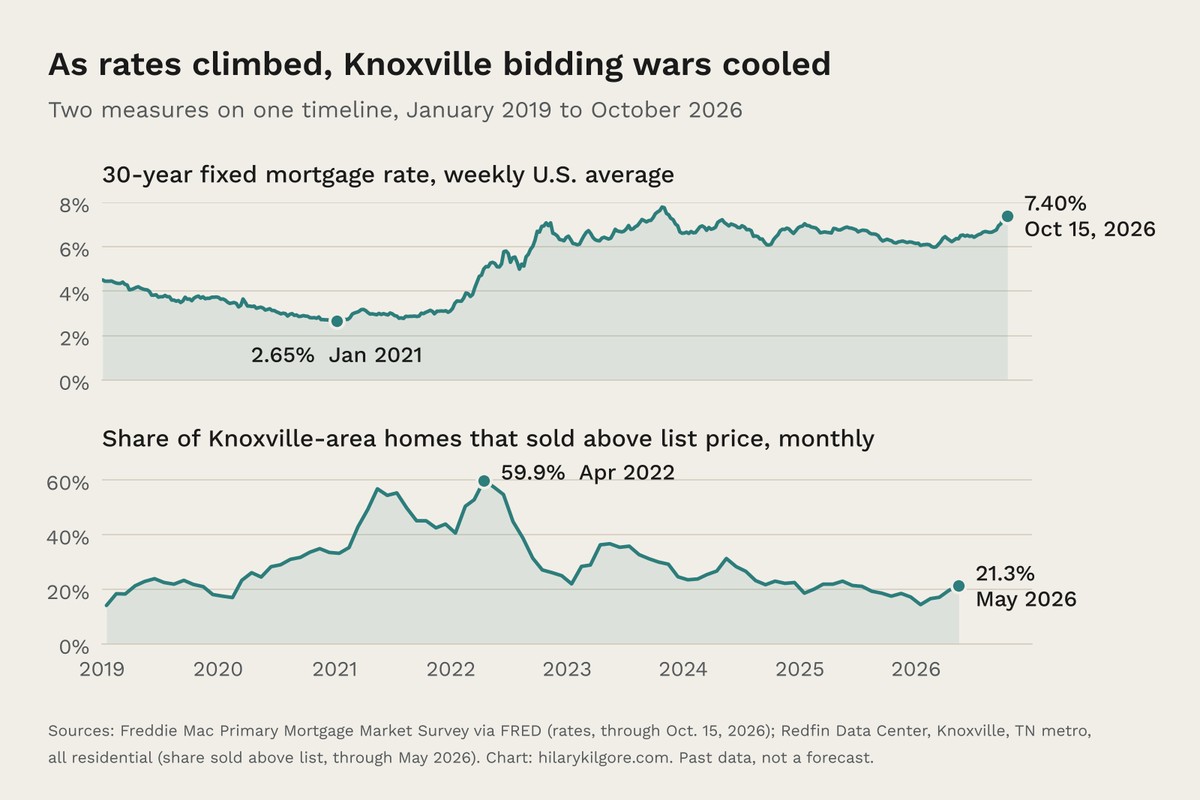
Start with where we are. Freddie Mac's weekly survey put the average 30-year fixed rate at 7.40% on October 15, unchanged from the week before after seven straight weekly increases. In late February it was 5.98%. The last time it sat this high was November 2023.
Now look at the other side of the scale. In September, Realtor.com counted 3,749 active listings across the Knoxville metro, the most for any September since 2018, and about two listings for every home under contract. In April 2021 it ran the other way: 679 listings for sale against 2,541 homes already under contract. The median listing spent 26 days on the market in April 2022. This September it was 60.
7.40%
30-year fixed average, Oct. 15, 2026
3,749
Knoxville-metro listings, Sept. 2026
1 in 5
Homes sold over asking this spring (6 in 10 in April 2022)
Rates are near their highest level in three years, and the share of Knoxville-area homes selling over asking is about a third of its 2022 peak. Sources: Freddie Mac via FRED; Redfin.
In other words, buyers in 2021 paid for their homes with competition, and buyers in 2026 pay for them with interest. Neither one is free. The question is which bill is bigger, and which one you can do something about later.
What a higher rate actually costs
Here's the same $400,000 house in each of those two markets. I've kept the numbers deliberately simple: 10% down, a 30-year fixed loan, and principal and interest only. In the 2021-style column, the buyer wins a bidding war at $20,000 over asking and the house appraises at the list price. In today's column, the buyer negotiates $5,000 off.
Same $400,000 house · 10% down · 30-year fixed · principal and interest only
2021-style market
Today's market
Rate
3.00%
7.40%
Price paid
$420,000 ($20,000 over asking)
$395,000 ($5,000 under asking)
Loan amount
$360,000 (90% of the $400,000 appraisal)
$355,500
Cash at closing
$60,000 ($40,000 down plus a $20,000 appraisal gap)
$39,500
Monthly P&I
$1,518
$2,461
30-year interest, if never refinanced
About $186,000
About $531,000
Payments above are principal and interest only. Property taxes, homeowners insurance, mortgage insurance, and HOA dues are not included and will change the actual monthly cost. Closing costs are not included in cash at closing. Every rate, payment, and dollar figure in this table is illustrative only, not a quote and not advice. I'm a REALTOR®, not a mortgage professional. Confirm every number with a licensed mortgage loan officer.
I'm not going to dress this up. Month to month, the higher rate costs far more. Today's buyer in that example pays about $940 more every month for the same house, and over thirty years the difference in interest runs well into six figures if neither loan is ever refinanced.
A rule of thumb helps me keep the scale straight. At today's rates, one percentage point on a $360,000 loan works out to roughly $250 a month. To add $250 a month through the price alone, you'd have to borrow about $36,000 more, which at 10% down means paying about $40,000 more for the house. So in monthly-payment terms, one point of rate is worth roughly 10% of the price.
That 10% figure is a rough rule of thumb built on illustrative numbers. It is not a quote, and it shifts with the rate, the loan size, and the loan program. I'm a REALTOR®, not a mortgage professional, so run your own numbers with a licensed mortgage loan officer.
On a calculator, the rate is the bigger cost by a mile. But the price is the part you can never refinance.
— Hilary Kilgore
What competition actually costs
If the payment were the whole story, every buyer would wait for lower rates. But competition costs things that never show up in a payment calculator, and in 2021 and early 2022 Knoxville buyers paid all of them.
What winning a bidding war used to cost
Paying over asking. In April 2022, about six in ten Knoxville-area homes sold above list price, and the average home sold for 103% of its asking price, according to Redfin.
Covering an appraisal gap in cash. Lenders base the loan on the lower of the price or the appraised value. When a house appraised below what you offered, you usually made up the difference out of pocket, on top of your down payment. That's the extra $20,000 in the example above.
Giving up protections. Shortening or waiving the inspection contingency was a common way to make an offer stand out, which meant living with whatever an inspector would have found.
Deciding fast. During the 2020–21 rush, the Knoxville Area Association of Realtors said half of local homes were being snapped up within six days. That's very little time to decide on the biggest purchase most families ever make.
Losing first. Writing offers on house after house before one sticks costs time, rent, and a lot of emotional energy.
None of that is a monthly cost, so none of it shows up when you compare payments. But it's real money and real risk, and the price you paid stays with the house for as long as you own it.
The rate might be changeable. The price isn't.
This is the difference that matters most to me. The price you pay is permanent. It sets your down payment, your loan balance, and your equity on day one. The rate on a fixed loan is permanent only if you leave it alone. If rates fall meaningfully while you own the home, refinancing may let you lower it.
I can't promise rates will fall, and I won't. A refinance has its own closing costs, requires you to qualify again, and depends on what the home is worth at the time. A licensed mortgage loan officer is the right person to tell you whether and when a refinance would make sense for you.
You've probably heard the saying "marry the house, date the rate." I'd add one condition: only date a rate you could live with for the life of the loan. If the payment only works because you're counting on a refinance, the house is more than you can comfortably afford at today's rate, and that's worth knowing before you fall for it.
Hilary's note
When a buyer asks me which one I'd choose, here's my honest answer: the market with choices, as long as the payment works at today's rate without counting on a refinance. I would much rather help you negotiate in a quiet market than help you win in a crowded one.
What waiting for lower rates could cost
Most buyers aren't choosing between 2021 and 2026. They're choosing between buying now and waiting. Nobody can tell you when rates will move, including me. But it helps to remember what happened the last time they fell hard. When rates dropped to record lows in 2020 and early 2021, the buyers who had been waiting came back at the same time. Knoxville-area listings fell from about 2,500 in January 2020 to 679 by April 2021, and the share of homes selling over asking climbed from about 17% in early 2020 to nearly half by April 2021.
So here's the same house one more time, with a hypothetical. In the first column, you buy now at 7.40% and negotiate $8,000 off the price. In the second, you wait, rates fall a full point, and you win a bidding war at $20,000 over asking.
Buy now or wait · Same $400,000 house · 10% down · hypothetical rates, not a forecast
Buy now
Wait for a lower rate
Rate
7.40%
6.40% (hypothetical)
Price paid
$392,000
$420,000 (appraises at $400,000)
Cash at closing
$39,200
$60,000 (includes the $20,000 gap)
Monthly P&I
$2,443
$2,252
If rates do fall to 6.40% and you refinance after two years
About $2,164, before refinance costs, on a new 30-year term
Not applicable
The 6.40% rate is a hypothetical for illustration, not a forecast. Payments are principal and interest only, and cash at closing excludes closing costs. Refinancing carries its own closing costs, restarts the loan term in this example, and requires you to qualify at the time. All figures are illustrative only, not a quote and not advice. I'm a REALTOR®, not a mortgage professional. Confirm every number with a licensed mortgage loan officer.
If rates do fall, the buyer who bought in the quiet market may be able to refinance and keep the better price. The buyer who waited gets the lower rate but pays for it at the closing table, with about $21,000 more cash in this example. And if rates don't fall, waiting didn't buy a lower payment at all.
To be fair to the other side: if rates stay high and inventory keeps building, prices could soften further, and a patient buyer could come out ahead. That's possible. I just can't promise it, and neither can anyone else. What I can do is make sure you see both sides of the bet before you decide to sit this one out.
Set your budget by the payment at today's rate, not the one you're hoping for.
How to use your leverage in today's Knoxville market
If you're buying now, the point of this market is that you can ask for things. Sellers are feeling the same inventory numbers you are; I wrote about what this market means for sellers earlier this week. Here's where I'd start on the buying side.
Using a buyer's market well
Run the payment at today's rate with a licensed mortgage loan officer before you shop, and set your budget by that payment. My post on the four numbers to start with walks through the basics.
Ask about seller concessions. A seller credit can sometimes fund a rate buy-down, which I explain in how mortgage rate buy-downs work.
Keep your inspection contingency. With homes spending a median of 60 days on the market, you rarely need to give it up. Here's what to expect from the inspection.
Look closely at homes that have been sitting or have had a price cut. About 1,750 Knoxville-area listings took a cut in September alone.
Negotiate on more than price: the closing date, repairs, and help with closing costs are all fair to ask for.
Get fully pre-approved anyway. Your leverage is strongest when your offer is clean.
Rates and competition are two different prices for the same house. Right now, Knoxville buyers are paying the first one, and in exchange they're getting time, choices, and room to negotiate. If the payment fits, I think that's a trade worth taking. If it doesn't fit yet, that's worth knowing too, and it's a conversation I'm always glad to have. Reach out any time.
Frequently Asked
Frequently asked about rates and competition
Is it better to buy a house now with a high interest rate or wait for rates to drop?
It depends on whether the payment works for you at today's rate. Nobody can reliably predict when rates will fall. In a market with less competition, like Knoxville this fall, buyers can often negotiate on price, ask for seller concessions, and keep their inspection contingency. If rates later fall, refinancing may be possible, but it isn't guaranteed and it has its own costs. If you wait and rates do fall, more buyers tend to return at the same time, which can mean paying more for the house.
I'm a REALTOR®, not a mortgage professional or financial advisor. Talk to a licensed mortgage loan officer before deciding when to buy.
How much does a 1% higher mortgage rate cost?
As an illustration, on a $360,000 30-year fixed loan at today's rates, one percentage point works out to roughly $250 a month in principal and interest. In monthly-payment terms, that's about the same as borrowing $36,000 more, or roughly 10% of the price on a $400,000 home with 10% down.
These figures are illustrative only, not a quote. Your actual cost depends on your loan amount, rate, and loan program. Confirm with a licensed mortgage loan officer.
Are there still bidding wars in Knoxville?
Some homes still draw multiple offers, but far fewer than a few years ago. According to Redfin, about one in five Knoxville-area homes sold above list price in spring 2026, compared with about six in ten in April 2022. Realtor.com counted 3,749 active listings in the Knoxville metro in September 2026, the most for any September since 2018.
What is an appraisal gap?
An appraisal gap is the difference between the price you agree to pay and the home's appraised value. Lenders base the loan on the lower of the price or the appraised value, so if a home appraises below the contract price, the buyer usually has to cover the difference in cash, on top of the down payment, unless the contract allows the buyer to renegotiate or walk away. How your contract handles a low appraisal is something to settle before you sign.
Can I refinance if mortgage rates go down?
Possibly. Refinancing can lower your rate if rates fall meaningfully, but you'll need to qualify again at the time, pay closing costs on the new loan, and the home's value will matter. It's a possibility, not a plan to build your budget around.
I'm a REALTOR®, not a mortgage professional. A licensed mortgage loan officer can tell you whether a refinance would make sense for you.
Let's Talk
Buying in Knoxville this fall?
Tell me what you're looking for and what payment feels comfortable. I'll show you what buyers are negotiating right now, and when you're ready for the next house, or the one after that, I'll still be here.
Thanks — message received.
Hilary will be in touch within a day or two. In the meantime, keep reading.